
As your business grows, so do your uniform needs. What starts as a few branded polos or safety shirts quickly becomes dozens of SKUs spanning job functions, regions, climates, and compliance needs.
At a certain point, uniforms stop being a simple apparel decision and become part of your daily operations.
Phase 3 helps companies build and manage scalable uniform programs through MediaLink, our centralized online platform. With MediaLink, you cut the friction of one-off orders. Instead, you simplify ordering and maintain brand consistency. This creates an easy experience for both employees and managers at every location.
For more insights into the power of MediaLink, please read this article.
When Your Uniform Program Becomes an Operational Necessity
Your uniform program becomes essential once your brand has a visible presence in the marketplace.
If you operate in retail, healthcare, real estate, construction, automotive, hospitality, or financial services, uniforms serve two critical functions:
-
Immediate employee identification
-
Consistent brand representation
In customer-facing environments, uniforms help people quickly recognize who represents the brand. In professional settings, they reinforce credibility and attention to detail. In regulated environments, such as healthcare or industrial workspaces, uniforms must also meet safety and compliance standards.
As you open new locations and hire more employees, inconsistency in uniforms becomes noticeable. Different fabrics, shifting logo placements, mismatched colors, and uneven quality can weaken your brand presentation and create internal confusion.
A centralized ordering system eliminates those risks.
Read more about how to maintain brand consistency across multiple business locations here.
The Challenges Leaders Face Before Centralization
Before moving to a managed uniform program, most leaders struggle with these issues:
1. Manual Ordering and Vendor Sprawl
When managers order independently from different vendors, the process is highly inefficient. In addition, approval processes vary, tracking becomes difficult, and budgeting lacks visibility.
2. Inconsistent Brand Execution
Different vendors apply logos inconsistently. Colors may shift between runs, and quality varies by location. These disparities erode brand standards over time.
3. Inventory Gaps and Overstock
Individual ordering leads to excess stock in some locations and shortages in others. With everyone placing their own orders, seasonal demand becomes difficult to forecast. New hires may have to wait for their uniforms because inventory is scattered or unavailable.
4. Limited Fit and Size Inclusivity
Without a centralized strategy, it becomes harder to provide inclusive sizing and role-appropriate apparel. Employees feel overlooked when proper fit is unavailable.
5. Operational Burden on Internal Teams
Uniform management often lands on one manager. That person spends hours each week coordinating vendors, distributing inventory, and resolving issues.
Without a structured system, these details create operational drag at a time when you need efficiency and scalability.
What a Successful Uniform Program Requires Today
Today’s uniform programs often feature:
-
Sustainable fabrics such as organic cotton, bamboo blends, and recycled fabrics.
-
High-performance materials with moisture-wicking, stretch, and breathability.
-
Inclusive sizing and gender-neutral designs.
-
Elevated customization using refined embroidery and controlled color palettes.
-
Modern, flexible styles aligned with professional workplace standards.
-
On-demand ordering to reduce waste and storage costs.
Keep in mind that your uniform program reflects your workplace culture, communicating who you are as an employer and as a brand.
How MediaLink Enables Scalable Control
As your organization grows, uniform management becomes too complex to handle informally. MediaLink provides centralization through a branded online portal that allows you to:
-
Host approved uniform catalogs by role, location, or department.
-
Provide on-demand production of customized and premium items.
-
Maintain an inventory of essential items.
-
Provide size charts and fit guidance.
-
Maintain logo consistency and brand governance.
-
Set user permissions and spending limits.
-
Manage multiple approvals and workflows.
-
Monitor ordering data and stock quantities.
-
Distribute orders from multiple warehouse locations.
This flexibility and accessibility are critical. High-turn roles may require stocked basics such as tees or caps for immediate distribution. Premium apparel or specialty sizing can be fulfilled on demand to reduce carrying costs. MediaLink supports both needs within one system.
In addition, the platform offers your team an easy e-commerce experience similar to Amazon or Instacart. Meanwhile, you gain full visibility and control over your program.
The Operational Details That Determine Success
The following elements are critical to building a program that scales smoothly and supports both your brand and operations.
Onboarding Experience
The onboarding process sets the tone for how your employees engage with the uniform program. New hires should have clear, simple access to the portal from day one. Build access links, login instructions, and ordering timelines directly into the onboarding workflow.
Spending limits and role-based permissions prevent confusion while maintaining cost control. Pre-approved bundles tailored by job function eliminate guesswork. For example, a field technician will see a different set of uniform options than a leasing consultant or sales representative.
Shipping options can align with your operational needs. Direct-to-home delivery may work best for remote hires. Bulk shipments to regional offices may suit high-volume locations. A strong onboarding framework removes delays. It also ensures your new team members present your brand correctly from the start.
Sampling and Fit Validation
Standardizing apparel without testing leads to dissatisfaction and unnecessary returns. Sampling allows you to evaluate fabric performance, comfort, durability, and logo application before committing to a full rollout.
In addition, be very intentional about the sizes and fits you offer. Provide a full range of sizes and clear size charts. Your employees shouldn’t feel limited in their options. Fit validation improves satisfaction, reduces reorder rates, and strengthens internal adoption.
Inventory Planning
Make sure your uniform program corresponds with your workforce cycles and business growth. Hiring surges, seasonal shifts, tradeshows, and regional expansion can affect demand.
Forecasting these cycles allows you to determine which items should be stocked and which should be produced as needed. For example, one of our clients keeps its inventory in a single warehouse. They handle their manufacture-on-demand needs at a separate facility that provides quick-turn embroidery.
You can also identify backup options, just in case. The inevitable supply chain disruptions, stock shortages, or seasonal production constraints can affect availability. A secondary approved option ensures continuity without damaging your brand.
Multi-Location Coordination
As your company grows, coordination becomes more complex. Multiple regions may require different climate-appropriate apparel or varying quantities based on headcount. Centralized oversight, paired with distributed fulfillment, allows you to maintain brand control while supporting regional needs.
When you design each of these important elements as part of a unified system, your uniform program will be scalable, manageable, and aligned with long-term growth.
What Organizations Often Overlook
Many companies evaluate uniform programs solely in terms of cost reduction. They focus on SKU counts and spend.
What they often overlook:
-
Employee feedback on comfort and fit.
-
The relationship between quality and replacement frequency.
-
The cultural signal uniforms send.
-
The sustainability implications of short lifecycle apparel.
One client shifted from quarterly uniform allowances to annual distribution by investing in higher-quality garments. The result was reduced waste, longer wear cycles, improved employee satisfaction, and a stronger brand presentation.
Quantitative analysis matters, but so does qualitative insight.
Uniform Programs as Brand Infrastructure
Your uniform program is an important part of your brand infrastructure. It influences how customers perceive you, how employees feel about work, and how efficiently your operations function.
When managed strategically, your program reduces manual workload, improves governance, and scales cleanly as your business grows.
Phase 3 connects sourcing and warehousing. It also provides on-demand production, packaging, and distribution. All these functions work together in a controlled system. With MediaLink, you remove internal bottlenecks in your uniform management program. It now fits into a clear and scalable system.
For more details on the importance of maintaining brand loyalty, please read this article.
Practical Impact: Uniform Centralization in Action
Tricolor Holdings
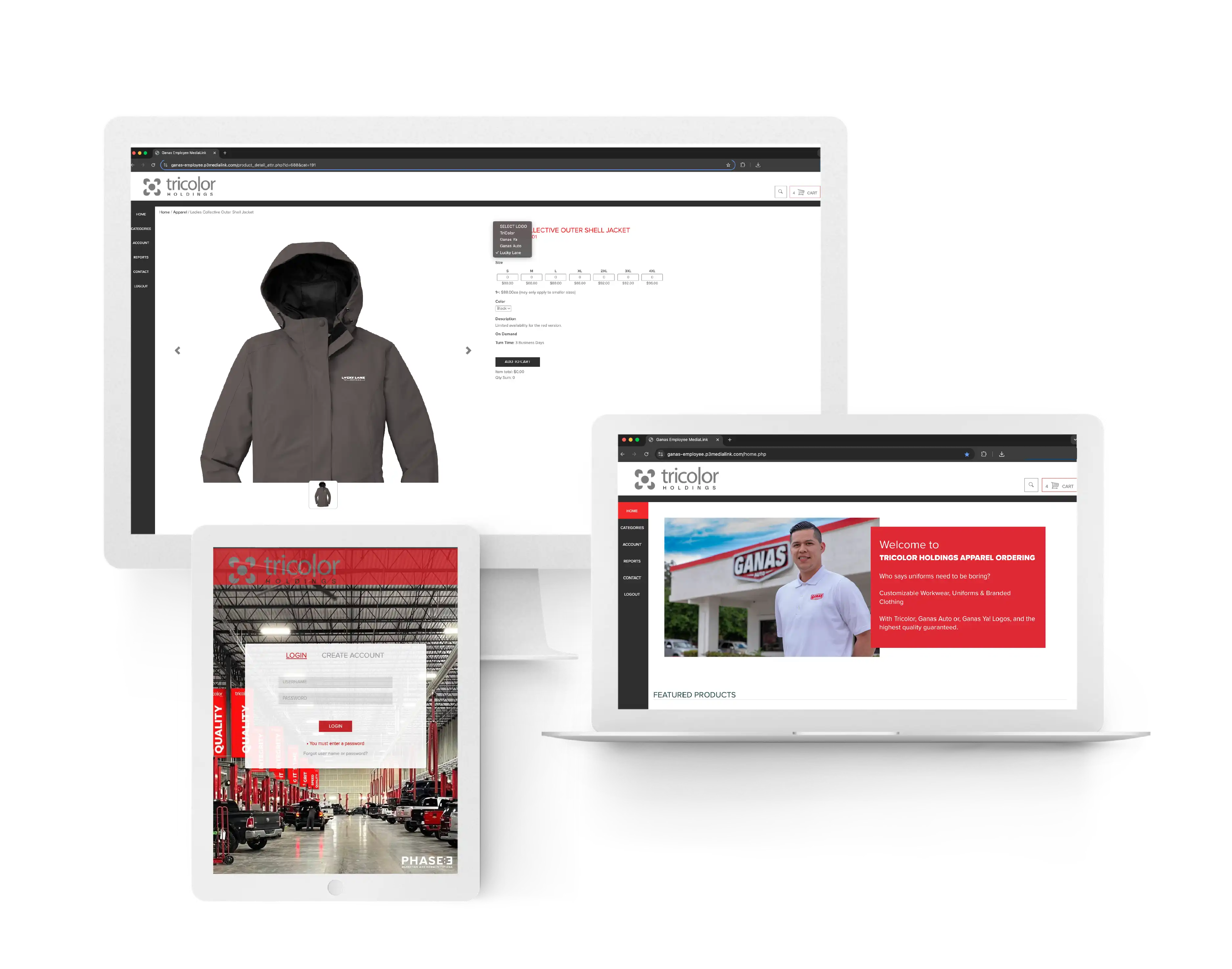
Tricolor required a scalable system to manage branded apparel across multiple subsidiaries. Phase 3 launched four MediaLink sites supporting 39 SKUs and more than 450 users. Each subsidiary and division has access to its unique logo and brand elements. Leadership maintains brand standards while employees seamlessly order role-appropriate apparel.
BNE Real Estate Group
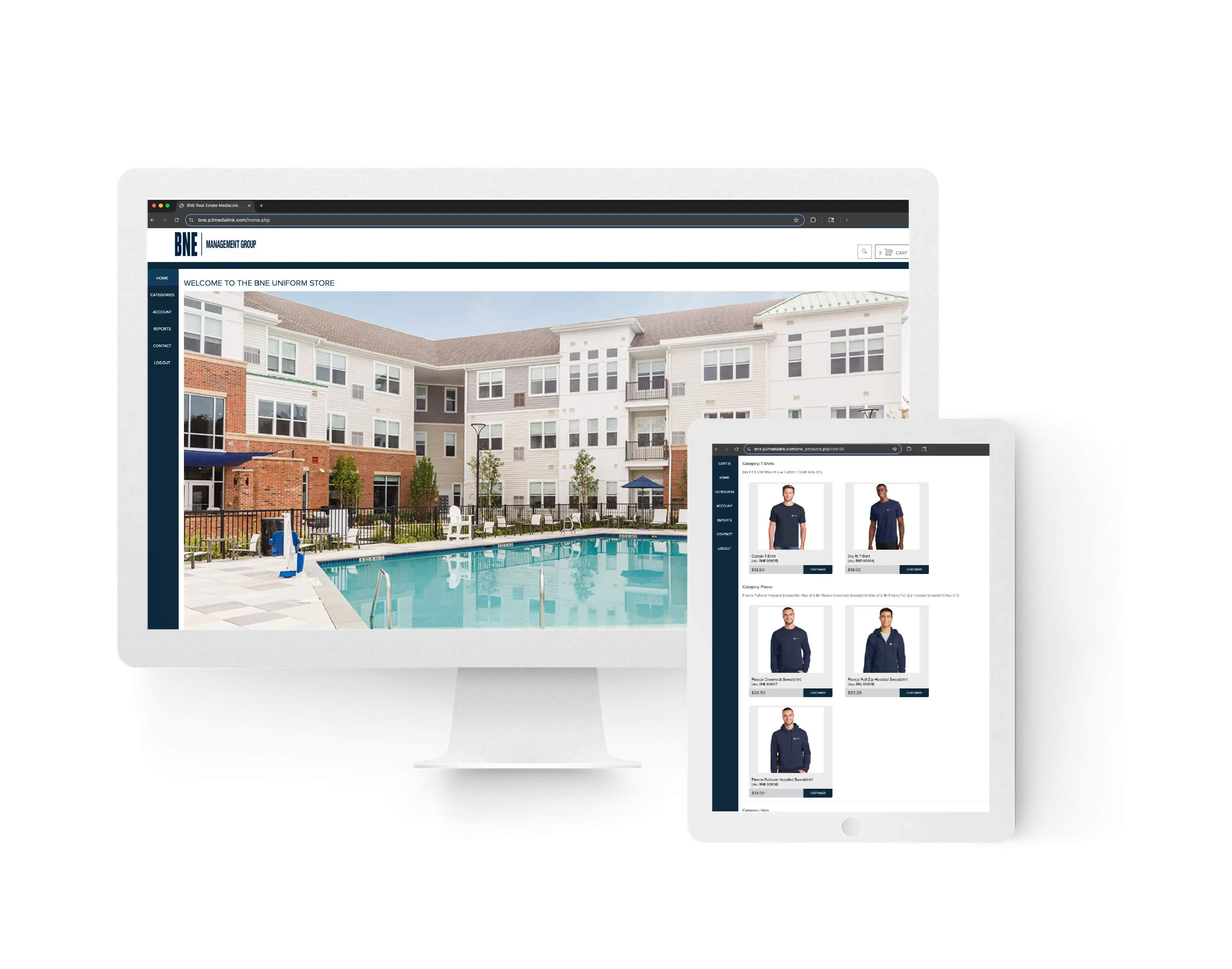
BNE, a national developer and operator of luxury residential communities, needed a more efficient way to manage its employee uniform program. Previously, property managers handled orders manually, and they stored inventory in a supply closet. Phase 3 launched a custom online store powered by MediaLink. This allows managers to easily place orders whenever they need.
After launching:
-
On-demand ordering replaced bulk inventory.
-
Storage costs were eliminated.
-
Order accuracy improved.
-
Program oversight dropped from several hours per week to approximately 1–2 hours per month.
With 80 SKUs across 25 locations, the program now runs efficiently without operational strain.
Control Without Complexity
As your company grows, you need systems that support expansion without increasing administrative burden.
A centralized uniform program protects your brand across every location, simplifies ordering, improves the employee experience, reduces waste, and creates operational clarity.
With MediaLink, Phase 3 builds uniform programs designed for scale from day one. If your organization is expanding across locations, roles, or regions, a centralized system may already be overdue.
Contact us today to learn how MediaLink can support your next phase of growth.